
Back to MphaR main website

Virtual Platform Website

Request Demo Version
%403x.svg)


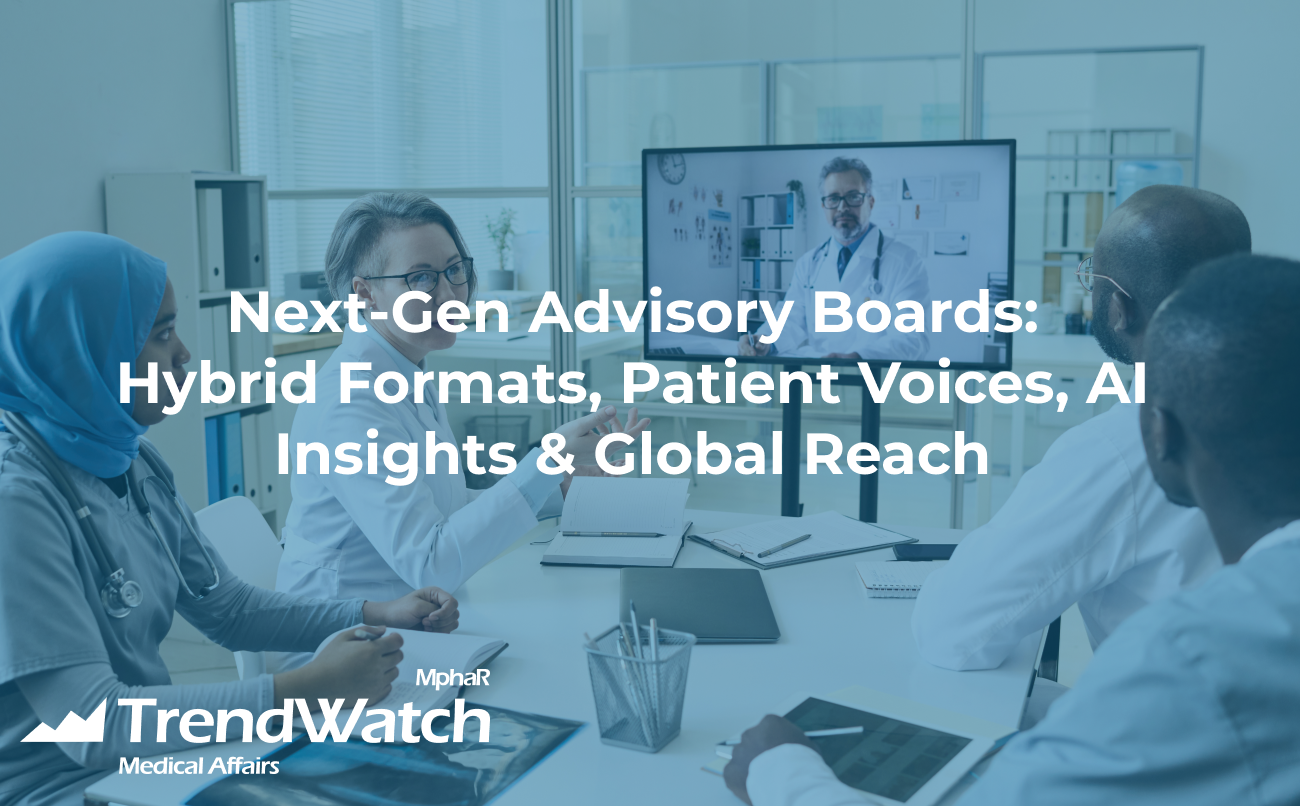
Advisory boards are undergoing one of the most significant transformations in the history of Medical Affairs. What was once a series of episodic, high-effort in-person meetings is rapidly evolving into a dynamic, hybrid, and data-driven ecosystem. Scientific exchange now extends far beyond the limits of a single room or a fixed agenda; instead, it’s an ongoing dialogue shaped by global reach, digital platforms, and analytical tools.
Artificial intelligence plays a central role in this shift, accelerating insight generation through sentiment analysis, real-time synthesis, and automated trend detection. At the same time, patient participation is expanding, fundamentally enriching the interpretive context of scientific decisions by adding lived experience alongside clinical expertise. This confluence of hybrid engagement, AI-enabled intelligence, and broadened stakeholder representation is redefining how Medical Affairs conceptualizes, gathers, and operationalizes advisory input.
Next-generation Advisory Boards represent far more than virtualization or convenience — they are hybrid scientific ecosystems intentionally designed to capture deeper, more diverse, and more actionable insights. At their core, these forums blend synchronous and asynchronous interactions, allowing experts and patients to contribute whenever and wherever they can. This shift revolutionizes reach and flexibility, breaking down barriers associated with geography, time zones, and travel.
Standardized digital platforms play an essential role in enabling this model, creating spaces where clinicians, researchers, patients, and other contributors can engage through structured prompts, discussions, surveys, and multimedia inputs. Medical Affairs teams are increasingly stepping into the role of shapers of these environments — designing the engagement pathways, ensuring regulatory and compliance standards are upheld, and curating the insight flows into meaningful outputs.
Most importantly, next-generation Advisory Boards are becoming continuous rather than one-off events. They operate as longitudinal scientific communities with multiple touchpoints across the year, resulting in richer datasets, more nuanced longitudinal insights, and scientific dialogues that evolve alongside evidence development. In this model, Medical Affairs is not just a facilitator — it becomes the central intelligence hub that connects the ecosystem.
Several converging forces are accelerating the transformation of the advisory board model into a global, intelligent, hybrid network.
First, hybrid inclusivity is breaking down traditional barriers to participation. Contributors who previously could not attend due to travel limitations, family commitments, clinical schedules, or regional constraints now participate fully. This inclusivity significantly expands diversity of thought, which is essential for complex therapeutic decision-making.
Second, AI amplification is revolutionizing how insight is gathered and interpreted. Through advanced natural language processing and machine-learning-based analytics, Medical Affairs teams can quantify sentiment, identify emerging patterns, and extract deeper thematic meaning from qualitative feedback. AI not only accelerates synthesis but also enhances precision by revealing nuances that may be overlooked in manual review.
Third, patient integration is becoming a defining feature of next-generation advisory structures. Patient voices bring essential context around lived experience, treatment burden, unmet needs, and quality-of-life considerations. As the industry shifts toward patient-centric design and value-based care, incorporating patient insights into scientific discussion is no longer optional — it is strategic.
Finally, globalization is reshaping advisory operations. Modern scientific questions require global perspectives, and digital platforms make it possible to gather insights across continents, time zones, and languages. Multilingual functionalities, asynchronous collaboration, and cross-border regulatory awareness create a truly international advisory ecosystem.
In this new landscape, Medical Affairs becomes the “intelligence orchestrator” — the function responsible for integrating human expertise, patient experience, and machine-assisted analytics into cohesive scientific understanding. The AI-enabled advisory board introduces capabilities that fundamentally elevate the rigor and speed of insight generation.
AI-driven sentiment and thematic analysis transform raw discussion into structured intelligence, quantifying tone, consensus areas, divergent viewpoints, and emotional drivers. Real-time synthesis capabilities produce on-the-spot summaries, enabling Medical Affairs teams to guide conversations with agility and precision. Trend identification across multiple sessions reveals evolving priorities, highlighting shifts in clinical practice, treatment barriers, or evidence needs. Participant optimization algorithms help identify which contributors are best suited for specific scientific objectives, whether based on expertise, experience, regional insight, or patient perspective.
This advanced model requires a cultural foundation built on inclusivity, analytical rigor, transparency, and trust. Every insight must reflect both the depth of human expertise and the objectivity of machine-supported analysis, with clear documentation of where AI contributes and where human judgment governs the interpretation.
Operating next-generation Advisory Boards demands a modern hybrid skill profile. Scientific expertise remains essential, but it must be complemented by digital fluency, comfort with analytics tools, and a higher level of competency in patient engagement. The mindset shifts from facilitating meetings to orchestrating continuous insight ecosystems, requiring strategic thinking, data literacy, and the ability to communicate across diverse stakeholder groups.
Several enablers support this evolution. Secure, compliant virtual platforms ensure that all interactions — whether synchronous or asynchronous — are protected by the appropriate data and privacy safeguards. AI insight engines expand analytic capacity but must include transparency and explainability safeguards to maintain trust with participants and regulators. Medical Affairs must also develop clear governance frameworks that clarify when AI can be used, how outputs are validated, and how human oversight is integrated.
Ethical considerations play a critical role. Protecting patient privacy and securing informed consent are foundational, and the increasing integration of patient voices requires sensitivity to power dynamics and cultural differences. Algorithmic bias mitigation is essential to ensure fair and equitable insights across global representations. Above all, inclusivity must remain at the core — ensuring that every participant, regardless of geography or role, is heard and valued.
Next-generation Advisory Boards represent a profound evolution in how Medical Affairs gathers, interprets, and operationalizes insights. Hybrid designs extend participation, AI transforms qualitative feedback into precision intelligence, and patient voices elevate the relevance and humanity of scientific dialogue. As global, inclusive engagement models become the new standard, Advisory Boards shift from isolated events to continuous networks — dynamic systems that connect experts and patients across borders and time zones. Medical Affairs stands at the center of this transformation, shaping a future where scientific decisions are informed by richer evidence, broader representation, and advanced analytical depth—and platforms such as MphaR’s Virtual Advisory Board Platform operationalize this vision in practice. Designed to support hybrid engagement, longitudinal advisory communities, and AI-enabled insight synthesis, MphaR provides the digital infrastructure that allows Medical Affairs teams to function as true intelligence orchestrators. By unifying global expert and patient participation, compliant virtual collaboration, and advanced analytics within a single environment, the platform transforms continuous scientific exchange into structured, actionable intelligence, reinforcing Medical Affairs’ ability to drive globally resonant, patient-informed strategies grounded in sustained, high-quality dialogue.

.png)
.png)
.png)
.png)
.png)
.png)
.png)
.png)
.png)
.png)
.png)
.png)
.png)
.jpg)
.png)
.png)
.png)

.png)


